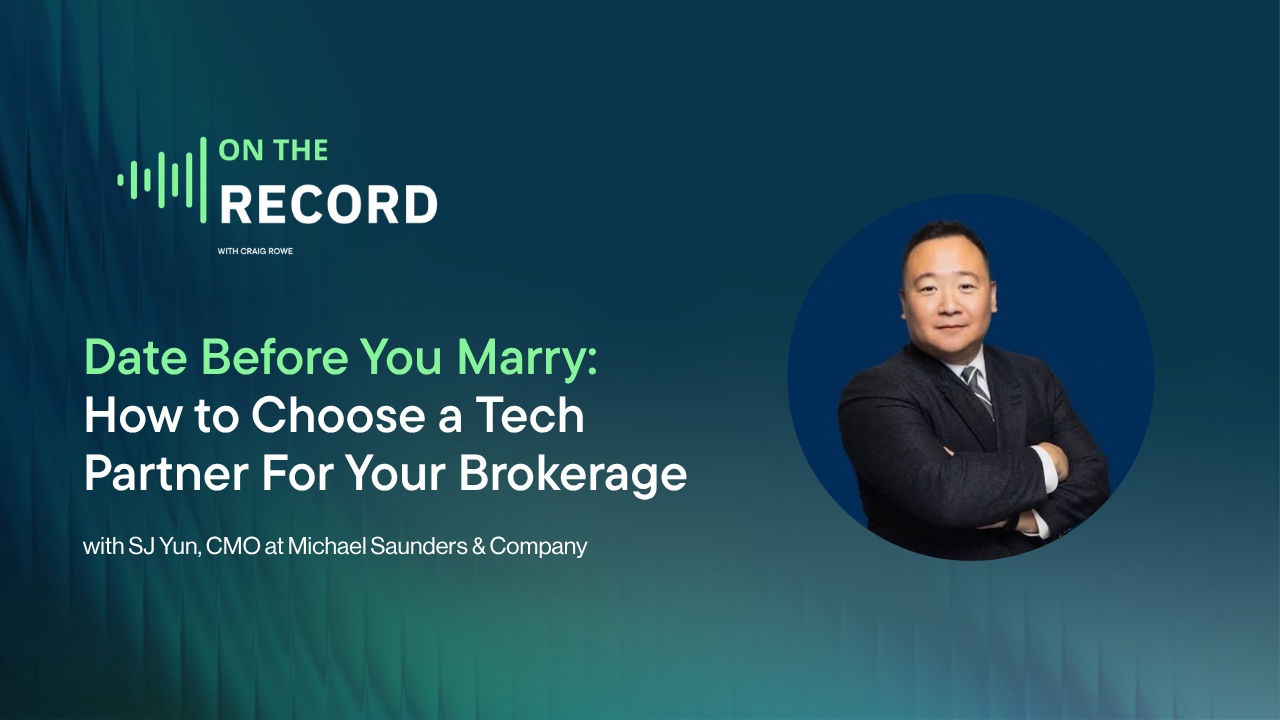
Would you sign a long-term contract with someone you’d never been on a date with? SJ Yun, Chief Marketing Officer of Michael Saunders & Company, doesn’t think broker owners should either.
In this episode of On the Record by MoxiWorks, SJ joins host Craig Rowe to share how his brokerage vets technology partners, and why he insists on calling them partners rather than vendors. SJ explains why Artificial Intelligence (AI) governance has become a leadership-level priority and what a clear AI policy should cover, from how agents use AI tools to how those tools access company data.
He walks through his approach to evaluating real estate technology: pilot programs before long-term commitments, support teams you can actually reach, and the direct question he asks every vendor about its long-term plans. He also shares how he drives agent adoption, what his brokerage learned from its return to MoxiWorks, and why he treats workarounds as a red flag. To close, SJ makes the case for storytelling as the most effective marketing strategy in a relationship business, especially as more agent content starts to look and sound the same.
On the Record by MoxiWorks, hosted by Craig Rowe, features conversations with real estate leaders on technology, strategy, and the future of the industry.
Let’s get engaged a little before we get married, right? For a long term commitment, because I want to make sure we’re partnering up with somebody that really wants us to succeed, not just say, here’s my tool, figure it out, enjoy, and here’s my bill. Right? And if you choose to use AI, which I’m not a huge fan of, always real estate agents are the best storytellers. Welcome to On the Record by MoxiWorks. I’m your host technology columnist, Craig Rowe. And joining me today is SJ Yun, Chief Marketing Officer of Michael Saunders & Company. SJ, thanks for joining me. What’s been on your plate this week? What’s been on my plate? What hasn’t been? There are a lot of entities entering the industry that want to provide that kind of support, soft sales, mentoring, document help, that kind of thing through AI. I’m sure you’ve seen it, I’m sure you’ve been Yeah, pitching on do you guys stand on that? Do you think that’s something the market wants to hear? That’s a great question. I think there’s a place where it needs to be properly, You need to look at it as a partnership with an AI platform or a solution, right? Yeah. Yes. You’d like to try and cut down on the human element of back and forth and the time it takes to process something. But I think it still needs some sort of validation or checks and balance against what the output is. And the reason I say that, and I’m just going to name drop totality, because that’s where I read the report from. They said last year, consumer confidence in real estate related answers was 33%, not high, not low, but 33% this year it dropped to 16%. So what does that tell you? AI is not going anywhere. People are still going to ask you questions, but they are looking for somebody to validate that. And that’s where our teams come in, Our real estate advisors or our marketing So you will have that partnership and that need to figure out, okay, if the output is to automate social pieces, right? For better or for worse, if you look at somebody’s feed and you can tell how much of it was actually AI generated or not, and it’s starting to look very similar to a bunch of others that are doing the same. So you really want a guy to say, okay, how can I help you distinguish between other agents that you are considering, whether you are a buyer and seller, what’s the challenge that you’re finding with most agent marketing today? And the number one thing on their list was everything looks and sounds the same. Yeah. So if you’re all using the same tool for the same solution with no human input or genuine authentic reasoning into it, it’s all going to deter and have the opposite reaction that you’re hoping for. Yeah, I could see that. It’s a good take. And these questions I’m leading you a bit, but I wonder why we’re not seeing more brokerages implement AI policy. And I’ve just straight up here is what our brokerage feels are the best practices using AI. And maybe it’s a little liberal, maybe they’ll allow, hey, if you’re going to use Claude or ChatGPT, these free models, please consider this. Or if you want to adopt a product that needs access to our systems, here’s how that’s going to work. And is this anything that you guys have talked about or are you hearing about in the It’s something that we talk about internally every week. Actually have an AI committee I to talk about think in general, talking about AI governance is a requirement, right? It’s not the sexiest thing to talk about when you’re talking about AI. That’s for sure. But there’s a reason why when you’re looking like when I’m on LinkedIn, a good friend of mine at another brokerage said he went through AI implementation leadership course through one of those institutions. And when you look at the syllabus, there’s actually two or three classes dedicated to just AI policy. That should tell you something and governance because that is true. Now, look, I’m as reckless as anybody else can be. And I’m in marketing, so I’m going to try and make those lines as thin as possible so I can cross them. But, and yeah, but especially with the digital marketing background and seeing how things can break as you talk about security, you talk about all these things that happen that expose you and can cripple your business, not just the brokerage, but an agent’s business, you have to take AI policy and governance very seriously. And you can’t… I think you have to break it down into chunks, right? There’s the AI best practices, which could fall under the policy of how to use it, what to do, what not to do. And then there’s the more nitty gritty stuff where you talk about implementation and integration with other tools, right? Because then AI policy really needs to dictate what you allow it to see, how you store the data, how long it keeps the data, that stuff that maybe generally agents don’t need to think about. But it is something that brokerages need to think about, especially at a leadership level, because when something goes wrong, it’s always that small thing that happens that will usually lead to huge risk and exposure. So how you perform software due diligence, what leads you to a particular product and feel free to get into the kind of the granular aspects of it. Do you consult with some of the agents in the company? And I’d love to hear kind of your take on that. So when it comes to that, I look at a few things and some of it is obviously reputation and references from other people that have used a platform or tool. But I really… For me personally, I wanna be able to make sure that they have a great support team, a person, not a chatbot that I can reach out to when there’s an issue. And look, not every platform is a 100% perfect. I get that. That’s the reality. And that’s why tools evolve and get better each time. But when things break, when you’re on the bleeding edge of technology and innovation, things are meant to break so that you know how to build it better. And that’s where the support team comes, right? Sales teams are great at selling a vision. Support teams are the ones that have to deliver on that promise of that vision. And support teams don’t get a lot of credit for it because they get the angry client all the time. Right? I look at that. I go out to agents and I solicit feedback and I ask them for advice and something that I’ve been going back to a lot of vendors that I speak with now is can I get a pilot program in place? I don’t want to sign. Let’s get, let’s date a little, let’s get engaged a little before we get married. Right. For a long term commitment. Right. Like, let’s see if this works and let’s see what the agents, the people that are actually using it. Our agents, trainer, our managing brokers because they have to encourage it. Let’s see what they say about it. Is this a useful tool to help you grow your business? Right. And is it effective? What’s the return on investment? Will we see adoption? Those are the types of questions that we typically ask and make sure that we get the best. We get the best out of the tool, the best bang for our buck, essentially. And it goes back to your earlier comment when you were prefacing this question. I feel like part of this industry is we don’t really have mentorship, even at the brokerage level. Would say we look to other brokerages as examples of look what the competition is doing. Could be a best practice because I see how successful it is. But when you look under the hood, see it’s a mess and it’s all wires going all over the place and it’s not the clean operating cog or wheel that you thought it was originally. I think a lot of that we do to ourselves. I think especially the prop tech space is filled with snake oil salesmen, unfortunately, that take advantage of that lack of insight or perspective that brokerages need to be able to assess. So I try to go, I don’t want to say aggressive, but a little bit more harder when we’re considering partners. And I truly use that word partners than vendors, because I want to make sure we’re partnering up with somebody that really wants us to succeed. Not just say, here’s my tool. Here’s my training guide. Figure it out. Enjoy. And here’s my bill. Yeah, I’m always really cynical about that, that the use of that phrasing from some companies we’ve partnered with, they’re paying you for it. You’ve provided, you’re providing. But if you but I think that comes down to the brokerage. Like you said, you have to be the one that holds them accountable for their promises made during the sales process, right? I do believe there are. Plenty of instances where it is a true partnership where, you know, your account person, if they’re out, you know who you can call, you can just reach them via text or for a quick solution. Those, I think, are true partnerships and the right prop tech company that is going to celebrate in your success. You just don’t disappear after the contract is signed. Right. I think that’s the ones that do stand out. Yes. Yeah. And then also. Yeah, go ahead. Oh yeah, it is. And I think what I was going say is a lot of that comes down to adoption, right? So I’d love to know what you do to encourage that. I’ve seen all kinds of models and talked to all kinds of brokers who have different approaches to it. And man, it’s hard. It’s hard. And I don’t know, I’m really interested in learning from what you’ve done to encourage adoption of products. I think there’s a few things. It depends on the tool. I won’t say we have a 100% adoption everywhere. I’d be lying. One does But I will say when I look at adoption, I want to take a look at who is exactly adopting it. Right. Cause if they are the users and typically are, and not unsurprisingly our biggest users are our top producers. Right. They want to grow their business. They’re, they are serious. They say, what do I need to learn to elevate my business and make more money? So they will take the time. So how do we get them excited about it? We build a communication plan to get them excited and understand the value of it, whether it’s a tool that’s just operational back office or something that’s front facing advertising or social media posts or print something like that. We want to make sure that they understand exactly what we are offering to them. Why? So that it’s not just, oh, look at our pretty tech stack. We have all these shiny pennies and we’re paying a lot of money for very low adoption. And at the end of the day, it’s why are we spending that much money if we could put it towards more of what things that are actually moving the needle. Yeah, for sure. Do you find like some of these top producers, are they a lot of them resistant? They hate say, look, I got here using this system or a lot of them open to change or adopting something new? I think they are open to it. I think typically, especially with top producers, they know if you’re not learning, you’re not earning. Right. So when, and they all are doing some form of what you are offering. So I’ll give you an example. Right. There, was a top producer that I knew they worked out of their Rolodex. I’m talking legit Rolodex and people who are not on of the age, essentially index cards on a little rolling thing that had names and contacts on there before cell phones. That’s where I know some agents who are top producing agents that work their contact straight out of that. And we ask them, you have to constantly be curious with what your top producers are doing. We ask them, what do you do? And something that I found consistent across all our top producing agents is they go over their database. So even if it’s not a CRM or it’s not on their phone, this guy on the Rolodex would go through and update his Rolodex on a quarterly basis. He didn’t just leave it there. He didn’t let it sit. Right. That’s not that different from putting it in a tool like MoxiWorks, for example, you could transfer that in there and do the same thing. So it’s the same concept. It’s just easier and you’re applying the same end goal. So you have to sell that vision, right? It’s the same thing. You’re just doing it using a different method of how to do it. And some adopt to it, some don’t, some are willing to try. Change management is painful, especially just even going back to AI policy. Change management is painful and usually it comes with a lot of enforcement. Right. And when you’re met with resistance, either decide, okay, let’s push through it and meet an end goal, or I’m just going to revert back to what I know and keep at it until I cap out and I’m done. And then I’m just going to say no to every tool that I see. So that’s, yeah, that’s where I’m at with that question. Yeah. Okay. I want to talk to you a little bit. I want to get a little granular for a second on change management. Yeah. You were with MoxiWorks for quite a while. Guys pivoted for a bit to an industry competitor, came back to MoxiWorks. Was that, did you have to manage that? Was a little more kid gloves coming into some of your agents and being like, Hey, all right, look, we’re gonna, we’re gonna shift back again. Like, think so. I think it went a lot smoother than we were anticipating it to be. And I think a lot of it came through communication. We let everybody know way ahead of time what we were doing. We wanted to train and make sure, okay, we’re taking something away. We’re bringing something back to the forefront for you. This is the value and this is how we can get you up to speed with what you need. But the third piece is we did a study. Okay. Again, not everything’s perfect, but you did love something on this other platform. Were the things that you loved? What do we need to find solutions for to make you feel like even though we’re giving you something, you’re not losing the things that you loved about it? And I think we found a lot of great solutions out of that study and just learning more about what our agents truly need versus what they say they want. And you really have to distinguish between that. Yeah, I think too that there’s probably a good, a healthy byproduct of you going through that process. Is that so often if in your traditional brokerage, if there’s a group of agents or a team or even one, I guess struggling with the technology product, they start to get distracted and think the grass is out there. And I think in this case you guys went out and maybe you said, I guess it wasn’t. We came back to what we know is going to work, what we know is going to give value to us and you may have eliminated that distraction. Right? So I’m speculating here, but I would imagine maybe the adoption rate is even better on this rebound, right? On this coming back. I think so. Think we were a little more aggressive on the education side and I say aggressive in a good way, right? I wanted to make sure that it was at ad nauseam that people understood what you get out of this tool, whether you decide to use it or not, at least, you know, what your step, what you’re stepping away from if you choose not to use it or what to look for if you’re looking for something else. But I think that’s at the agent service. And I think at a brokerage side, we really built out a thought process and a metric or a rubric for, okay, this is how we need to assess any partner that we want to partner up with. So when we go talk to partners, how receptive are you to feedback and change and how big are you to implement it? Or are you more, this is what it is. This is what you get. And then that’s more of a platform and a vendor that you’re talking to. When I talk about partners like MoxiWorks, I’ll always give feedback and they say, okay, we’re going to try this. It may not work, but this is what we think is the best solution for example. And, you know, and we’re very happy with that. And that’s the relationship that I’m looking for when we’re assessing partners, who can we talk to and communicate with truly that will hear us, right? Because yes, I’m not a licensed agent, but I hear from our agents all the time and we want to make sure we give them the best. So if they are telling me that something’s not working, I take it very seriously as a responsibility to work with our partners to make sure that they find a solution for it, because that’s the big thing on every PropTech site. We offer a solution. And when I hear, start hearing things like workarounds that are not true solutions, I get a little deaf in the ear and I start seeing red flags. Yeah. Funny you mentioned that. I did a lot of work with a brokerage on some product consulting and we ran into some of those issues with a vendor that was offering workarounds, not a direct solution. And to me, a workaround means you’re not solving anything. We can find a workaround. Yeah, that’s why we’re coming to you, right? Yeah. Did you have any was there? Did you have to upsell coming back to MoxiWorks? I think you have to, yes. I think we, you have to do a whole study, right? You have to, and I think it’s not about trust. I think it’s about demonstrating value, right? And articulating it. I think they’ll trust that you’ll do your due diligence to come to the right conclusion, but you need to demonstrate that you’ve done your due diligence. And I think if you can make a strong case and they ask questions, you should be expecting a lot of hard questions about did you think about this? Did you think about that? What are we taking away? What can we provide them in return? What is the X factor with cost that comes into play? Really, all comes down to service and money. So how are we comparing the information and the value of decisions that need to be made if we decide to move out? What does the communication plan look like if we decide to move forward with it? So we try to go through a whole journey and it may seem like brain damage to some, but I think it’s necessary brain damage to have those conversations ahead of time before you flip a switch as quickly as signing a contract, right? You don’t want to go through that. I’d rather go through it now than later, unfortunately. Yeah. One thing I talked to if a broker asked me about a software product and industry events and stuff, I get that a lot. And one thing I quickly advise them on is what is the status of the vendors you’re considering? There’s been a lot of consolidation in PropTech over the years, right? There’s not a ton of big enterprise players And a lot of that’s because they’re taking on other companies. And I often ask us make sure that the company itself, vendor has their own ducks in a row internally. They’re going through a number of acquisitions and there’s all kinds of products they’re trying to integrate. Like behind the curtain. It could be a real mess and it doesn’t take much for that to bleed onto the stage. And suddenly the customers are seeing the ill gotten, seeing that it’s not benefiting them when it’s a big mess behind the scenes, they just can’t get the attention and support that they need. Is that something you’ve looked at over the years as well? Like, what’s the status of these And software again, this is a relationship business. So, you know, lot of vendors, meet a lot of owners, prop tech owners, I think depending on how close your relationship is and when they’re pitching you something, I do ask them transparently, are you building this to sell? Are you building… What’s your long term plan here? Because I got to think about support. And yes, there’s short term solution and long term solutions and things are always in a state of growth, but I have my immediate business needs, what I need to solve. But I do ask them if you’re looking to sell, that’s not a deal breaker for me. Right? Do understand the economics work. Right? Yeah. They have a business to run. They have a business to run, but is the value of the platform that you’re offering there? Are you, is there a roadmap in place? What is on that roadmap? How are you adding to this roadmap? Is it coming from feedback from clients? Where do your developers at? I try to look at all those little things. It doesn’t always add up to the final decision. Have they done layoffs? How they’ve done consolidations? But I do, depending on my level of relationship with them, do ask them flat out, are you looking to sell? And that usually leads us down a conversation of what the long term goal is and how much they are ultimately invested in developing their product. Right. Because it’s very telling, because just going back to my earlier point, I’m looking for partners. So if you’re looking to sell, that’s fine. But if you’re not looking for feedback as you’re looking to sell and making changes to your product to make it a better sell for your next acquisition, then obviously you’re looking for a quick payday and I’m, you know, I’d like everybody getting paid, but that’s yes. This is why I like doing these interviews. That is great advice. Dig into that vendor, right? What are they really thinking down the road? And relative to the roadmap, I want to know if you have tons of like a lot of times they’ll have these lengthy roadmaps with lot of big product upgrades or big changes. But that makes me think is like how much of your support in engineering is going to be dedicated to all these changes, all these product updates. And also who else are you listening to? What’s driving all this change? Is there a real reason for it? Have you talked to your customers about all that change? Because that can be distracting for the customers, right? Especially if you’re onboarding, right? If you’re going through the process initially learning the product, it can be a real challenge. And when I’m with whether I’m actively engaged in talks with a vendor or I’m actually engaged with a vendor or partner like MoxiWorks, for example, I will always ask if you’re rolling out a new platform like rise, for example, what does the beta test look like? Can I get early access to it? Who doesn’t want to play with something ahead of time? Right. Because the earlier I can get in on it, the quicker I can provide feedback. Right. And if, know, the support team is there to advocate for the changes that we’re looking for, I’d rather be at the front end of it than the latter end. Now if somebody’s launching a fresh new product and it’s untested and they’re not open to any change, any feedback, guess what? I don’t want to be a guinea pig. I think I learned that many times over. Yeah, no doubt. Let’s get in a little bit to more of some traditional business concepts here. I want to know what’s working for agents and brokerages on the marketing front these days. Like I know social is the easy just default for agents because it’s cheap and it’s easy to do. But I’d like to know like how your fact, what strategies you’re taking in. Are you looking at consumer metrics and behavior? Are you getting really granular with it? Yeah. Let’s talk a little bit about that. What’s working. I’ll start off with what I’m looking at and then I’ll tell you what’s working. Okay. I try to look at everything and I’m not being facetious, but I look at website analytics, for example, I look at heat mapping. What are they clicking on? How much time are they spending on the website? Are we comparing it against last year’s data? We launched a new website this year, comparing it against last year’s data. How does that come into play with the traffic that we’re seeing? What are the sources of it? Who’s spending money? Things like that. So when we look at that data and then we start talking out into the field with our agents, I start asking, I essentially survey everybody, right? Because you need a continuous feedback loop. I find that’s part of the strategy that is necessary because yeah, it’s data and I like to be data informed, always data driven, right? Because there’s a little bit of gut that is involved with decision making, but I don’t want to do it blindly, right? I want to look at the data and make the best judgment based on what I’m hearing from the field. And when I hear from the field, agents are telling me, okay, we need more of this, we need more of that. More doesn’t always necessarily mean more quantity, It could also translate to quality. It’s important to make the distinction in how I can solve for it. So what’s working? Would say when I look at data overall, I try to put my finger on the pulse. You heard me cite all these other studies of what’s going on. I try to package it up. I don’t keep it to myself. Don’t, my job is to make sure our agents are armed with that information. So going back to communication, education, keeping the lines open so that they know what is happening in market and what’s available to them, how they can leverage it for their marketing, think is probably the strongest tool. I’ll sum it up in one word essentially. It’s storytelling that is the strategy. Storytelling in their social media, for example. And if you choose to use AI, which I’m not a huge fan of always, but if you trip, what is the storytelling you want to do, whether it’s with the listing, your brand, the neighborhood that you’re working, people are looking for a hook to stay engaged, right? Meta didn’t pay $17,000,000,000 for social addiction if it wasn’t a real thing, right? Like, yeah, when you look at that and you’re like, wow, people do get hooked on content. So if they’re not really resonating with the content that I’m sending out there, then something’s missing. Like, I’m not thinking about what my story is. Right. And it comes down to fundamentally what is the values that you want to show. Right. And usually I walk in and when I speak with agents and they say, how can I either I’m new to business or I’m trying to get back into the business or anything like that? I say, write down all the reasons why somebody should work with you, whether they’re a buyer or seller, right? Just write it down. And then look at your social, look at your Google footprint. Look at what ChatGPT is saying about you. Do any of it does that jive with what you’re seeing? Right. And if it’s not, what is the storytelling that you need to do? Use that as your reference point. That’s a great way to put it. Yeah. Tell that story. Tell it in a series of posts, right? Whatever it may be. And you know what I noticed my thousand years in this business, but what I noticed is the best real estate agents are the best storytellers. Yeah. I think storytelling is consistently the strategy that I’ve seen work in its many permutations and iterations, right? Whether it’s in their print, how they’re telling their story, whether it’s in social. And I don’t mean like, oh, okay, this is my listing. This is my soul history. True. Okay. This is the challenge we faced and this is how we overcame it. And this is how we navigated it. The story is you be, be yourself. And people that bake that into the story. So fundamentally, even with storytelling, this is again, I hate to sound like a broken record, but this is a relationship business, right? And if you’re looking for to build a relationship with a client, you need social proof and in social proof with that relationship, stories are the best way to build that relationship. Yeah. Yeah. So however you want to tell that story, whether it’s through video, a series of posts, maybe it’s a blog in your site, but you got to get that in front of the consumer, which is not easy, right? That’s it’s not easy. Fighting for attention is rough. I encourage anybody to just start somewhere. Right. I think if you let perfection get in the way of good or then you’ll never start. Right. So like Mona Lisa, I believe isn’t even a completed work of art, but look how many people come to visit. Right. I think part of marketing too, is sometimes you have to spend money to figure out what doesn’t work. Sure. And I think, yeah, I think you have to also come to the realization that if you are running your own business as an agent, that yes, automation sounds great. Using AI sounds great. Getting things faster is great. But if you are trusting a tool to do everything for you, I think you have a challenge with really differentiating yourself and building value and people will see right through it, unfortunately. People come and say, sometimes sit with us and they’re like, I’m just looking for a platform that will automate all my social posting for me. It will automatically create all the content, not just listing content. I want it to tell neighborhood. Okay. But where’s your voice in it? And I think you have to look at it as a scale or a pendulum. Right? And even going using AI governance as an example, the more you want to use AI and it swings one way. Right? It’s even more important on the other side of that pendulum to focus on governance and enforcement. The more you focus on marketing automation, the more time you have and value. It’s even more important to focus on how do I make sure that I’m an individual and getting that point across with my marketing and storytelling that this, that when I’m doing an e blast, that this still feels special and authentic. And if, if that time is not being spent in that level of thought, and you’re just auto hitting a button and expecting everything to be done, you already lost that you need to reset and talk to your partners or talk to your agents and really think about what your strategy is. Ashjay, that was a great way to wrap it all the way back around to AI policy and all that sort of thing. This has been great. I want to thank you very much for your time for joining MoxiWorks with On The Record. And please if there’s any way people would want to get ahold of you or ask you questions or kind of glean that knowledge without revealing too much, how can people get ahold of you? Can hit me up on LinkedIn or they can email me at sjyunmichaelsaunders.com So you can find me and my footprint is available and large and wide there. Great. Thanks so much for again, for joining us. And again, I’m Craig Rowe, and this has been On the Record with MoxiWorks. Thank you.