

Key Takeaways
TL;DR
- A real estate brokerage business plan for 2027 should turn your goals into a few measurable targets, then show how your agents, data, marketing and technology will hit them. The strongest plans are short, owned by named people and reviewed every month, so you can adjust as the market shifts instead of waiting for year-end.
- Pick three to five measurable goals for recruiting, retention, agent productivity and profitability.
- Give agents connected tools that cut busywork, from listing marketing to CMAs and presentations.
- Review a short scorecard every month and act on what it shows.
- Automate routine marketing and follow-up so agents spend more time with clients.
- Build a connected tech stack that can grow and change with your brokerage.
Most brokerage owners don’t need a longer plan for 2027. They need a clearer one. Agents want support that saves them real time. Costs keep climbing. New tools arrive every month, and each one promises to fix everything.
A strong real estate brokerage business plan cuts through that noise. It names what you want to achieve, who owns each piece and how you’ll know it’s working. It also leaves room to change course when the market does.
This guide walks through five steps for strategic real estate planning in 2027, with questions to ask yourself at each stage. Use them to build a plan your leadership team can run and your agents can feel.
Jump to What You Need
- Set the Foundation With Goals You Can Measure
- Empower Your Agents to Be More Productive
- Use Data for Smarter Brokerage Decisions
- Use Digital Marketing and Follow-Up for Maximum ROI
- Plan for the Long Term: Innovate and Adapt
- Frequently Asked Questions About Brokerage Business Planning
1. Set the Foundation with Goals You Can Measure
Every good plan starts with an honest look at where you are. Before you set a single target, look back at 2026. Which offices or teams grew? Where did agents leave, and why? Which costs rose faster than revenue?
Then choose three to five goals for 2027 and make each one measurable. “Grow the brokerage” is hard to act on. “Increase the number of productive agents by the end of Q4” gives your team something to aim at and a way to track progress.
- Focus on a few core areas. Agent engagement, recruiting and retention, profitability and operational efficiency cover most of what drives a brokerage.
- Give every goal an owner and a date. A goal without an owner tends to drift until the next planning season.
- Work from the same information. One connected CRM for contacts and tasks means leadership, staff and agents all see the same picture.
- Build in flexibility. Write the plan so you can adjust targets each quarter as the market shifts.
Not sure where growth should come from? See how to grow your real estate brokerage for ideas on recruiting, retention and new revenue.
2. Empower Your Agents to Be More Productive
Agents are the backbone of your brokerage. When their days fill up with admin, formatting flyers or digging through scattered contact lists, there’s less time for the conversations that lead to business. So before you add anything to your 2027 tech budget, ask a simple question: will your agents actually use it?
Many brokerages have paid for a tool, rolled it out and watched almost no one use it. Often the problem isn’t the agents. It’s a tool that only works when agents can slow down and sit at a desk, which isn’t how real estate works. Our guide, How to Choose Marketing Tech for Your Brokerage, boils the decision down to three questions:
- Does it save time? Will it reduce decision fatigue and friction in an agent’s day, including between appointments and in the car?
- Does it drive action? Will it surface opportunities at the right moment, or rely on agents to remember, search and follow up?
- Does it give you control? Does it protect your brand, respect agent data ownership and make it clear what the system is doing and why?
In practice, that means looking for tools that help agents:
- Launch listing marketing automatically, so every listing reflects your brokerage’s brand without extra effort.
- Create standout client presentations, including comparative market analyses (CMAs) and buyer tours, and share them in a few clicks.
- Start the day knowing who needs attention, why and what to do next, instead of digging through the database.
- Review, edit or skip suggested follow-up before anything goes out.
When you sit in on a demo, ask questions like “What can an agent realistically get done in five minutes between appointments using this tool?” and “When the system suggests an action, can you show what triggered it?” Clear answers are a good sign. Vague ones usually mean the tool wasn’t built for how agents work.
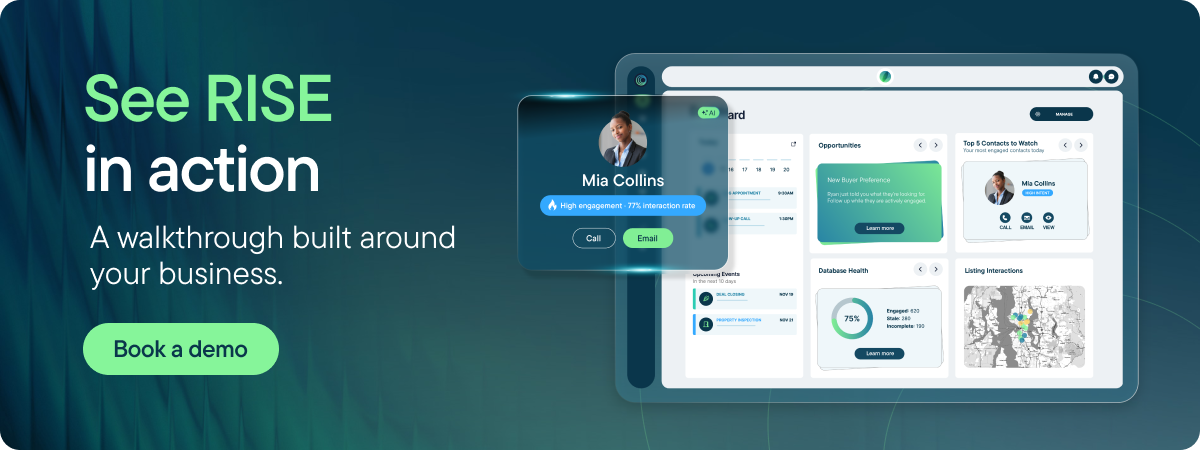
In RISE by MoxiWorks, agents can create and share branded CMAs and presentations directly. Top Contacts ranks the people in their database by signals like property views, email engagement, saved listings and time since last contact. Agents get plain-English context and AI-drafted messages that they review and approve before anything goes out.
Well-supported agents are also more likely to stay. For more on what keeps productive agents loyal, see real estate agent retention: what top producers want.

3. Use Data for Smarter Brokerage Decisions
Data turns your plan from a wish list into something you can manage. You don’t need a complex dashboard to start. You need a handful of numbers you trust and a regular habit of reviewing them.
Start by connecting your sources. When your CRM, MLS and marketing data work together, agents get timely prompts on who to contact and why, and you get a clearer view of what’s working across the brokerage. Then decide which numbers matter most:
- Productive agents: How many agents closed at least one transaction this quarter?
- Transactions per agent: Is productivity rising, flat or slipping?
- Agent retention: Who left, when and why?
- Marketing results: Which channels bring in engaged contacts, and which cost more than they return?
- Follow-up: How quickly do new inquiries get a response, and from whom?
Actionable insight: Put these numbers on a one-page scorecard and review it monthly with your leadership team. Pick one or two changes to make each month, rather than trying to fix everything at once.
4. Use Digital Marketing and Follow-Up for Maximum ROI
Buyers and sellers start their search online, and they expect quick, personal responses. Your brokerage’s marketing should help agents stay visible and keep conversations going without adding hours to their week. Automation makes that possible.
- Run listing ads where people scroll. MoxiWorks Promote, built into RISE, runs listing ads on Meta to reach the right audience. Housing ads on Meta run under the Special Ad Category, so focus on the listing and the area rather than demographic targeting.
- Keep contacts engaged with behavior-based email marketing. Set up campaigns triggered by listing events, dates or contact tags, so the right message goes out at the right moment.
- Make follow-up someone’s job. Every inquiry should have a clear owner and a response-time target.
- Keep your brand consistent. Templates and automated marketing help every agent present your brokerage the same way.
Pro tip: Make your marketing work harder by automating repetitive tasks, so your agents can focus on client relationships. For ideas, see 5 easy ways to use real estate marketing automation.
5. Plan for the Long Term: Innovate and Adapt
The real estate landscape keeps changing, from interest rates and inventory to how clients find and choose agents. A long-term growth plan doesn’t try to predict every shift. It builds a brokerage that can respond to them, and that starts with your tech stack.
How many tools is your brokerage paying for, and how many do your agents actually use? The average brokerage used 20.4 technology tools in 2023, up from 12.4 in 2020, according to the 2023 State of Real Estate Brokerage Technology Survey from TotalBrokerage and T3 Sixty. Every extra tool adds cost, another login, more training for new agents and client data stuck in separate systems, so agents end up entering the same information twice.
Think of your tech stack like your phone. Nobody carries one phone for texting, another for calls and a third for voicemail. One device does it all, and that’s what makes it useful.
- Consolidate one step at a time. You don’t have to replace everything at once. Start with the tool your current stack handles worst, then bring two, three or four tools together over time.
- Choose connected tools over a patchwork. Most agents need a CRM, email marketing and listing presentations. When those share one login, agents enter a client once and use that information everywhere.
- Build a tech stack that can evolve. Pick platforms that add new capabilities over time and connect to the other systems you rely on through integrations.
- Plan for people, not just tools. Recruiting, agent development and leadership succession all belong in your long-term plan.
- Schedule regular check-ins. Revisit the plan each quarter and ask what’s changed and what that means for your goals.
RISE brings CRM, email marketing and listing presentations together behind one login, with native AI built in, and connects to other systems through integrations. Broker owners can start with the piece they need most and add more when they’re ready.
2027 isn’t just another year on the calendar. It’s a chance to rethink how your brokerage runs. Clear goals, supported agents, trusted data and connected technology give you a plan that holds up when the market shifts. Start with one section of this guide, bring your leadership team together and build from there.
Frequently Asked Questions About Brokerage Business Planning
How Do I Build a Business Plan for a Brokerage?
Start by reviewing last year’s results, then set three to five measurable goals for agent engagement, recruiting and retention, profitability and operational efficiency. Give each goal an owner and a date. Then plan how you’ll equip agents, which numbers you’ll review each month, how you’ll automate marketing and follow-up, and when you’ll revisit the plan.
How Can Brokers Help Agents Be More Productive?
Remove repetitive work. Automated listing marketing, presentations and CMAs agents can create in a few clicks, and a CRM that shows who to contact next and why all free up time. When you choose new tools, ask whether they save time, drive action and give you control, then automate routine marketing so agents can spend more of their week with clients.
How Can Brokers Use Data to Make Smarter Decisions?
Connect your CRM, MLS and marketing data, then review a short scorecard every month. Track productive agents, transactions per agent, retention, marketing results and follow-up speed, and use what you see to adjust your plan.
How Can Brokerages Automate Lead Routing and Follow-Up?
Use a connected CRM and email marketing so new contacts are captured in one place and campaigns run automatically, triggered by listing events, dates or contact tags. Then make sure every inquiry has a clear owner who follows up quickly.
What Should a Brokerage's Long-Term Growth Plan Include?
Clear goals and the metrics behind them, a plan for recruiting, developing and retaining agents, and a tech stack you can consolidate over time, with fewer tools behind one login. Add regular quarterly reviews so you can adapt as the market shifts.