A new listing goes live, and the seller wants a social post by tonight. That means your real estate agents need marketing materials, fast.
Add to that the other essentials: a presentation for tomorrow’s appointment, a flyer, an email, and an open house graphic.
You don’t need a team of graphic designers working day and night. You need to empower your agents to master real estate graphic design themselves.
If you’re worried about hundreds of different interpretations of your brand running loose in the market, or agents spending more time fixing images than selling homes, that’s a fair concern.
In this article, we’ll explore why real estate graphic design skills are no longer a nice-to-have for agents, and share the tools and rules they can use to create professional, recognizable marketing fast, without creating a brand-control headache for you.
Jump to what you need:
- Real Estate Graphic Design: Why Should Brokerages Skill Up Agents?
- What Design Skills Your Real Estate Agents Need To Master
- How To Ensure Consistency
- The Best Real Estate Design Solution For Brokerages
- FAQ on Real Estate Graphic Design
Real Estate Graphic Design: Why Should Brokerages Skill Up Agents?
Design matters more than ever. Buyers make decisions on screens before they walk through a door, and what they see can stop them from reaching out or persuade them to choose you over a competitor.
According to the National Association of REALTORS® (NAR) 2026 Home Buyers and Sellers Generational Trends report, 52% of buyers found the home they eventually bought online, and 81% of buyers who searched online rated photos as very useful. That’s not a few people with a preference. That’s the majority of your pipeline forming an opinion before an agent says a word.
The challenge is that design needs to feel customized to each locality and agent, while still meeting brand standards.
Even the best in-house design teams often can’t keep up with requests from hundreds or thousands of agents.
That gap leads agents to take matters into their own hands, and that creates common issues:
- Unbranded or poorly branded content
- Messages that don’t align with the core values of the brokerage
- Dilution of current campaign messaging
- AI-generated content that doesn’t match the look and feel of the brokerage
What Design Skills Your Real Estate Agents Need To Master
To be clear, your agents shouldn’t be expected to produce every piece of client-facing material at every stage of the relationship.
But a seller should recognize the same brokerage whether they see the listing on Instagram, get a postcard, or sit through a presentation.
Here are the areas where it’s most beneficial for agents to get hands-on.
Listing marketing
This is where weak design gets noticed fastest. A single listing can need property photography, floor plans, social graphics, open house materials, price change announcements, “Just Listed” and “Just Sold” posts, digital ads, brochures, and email campaigns.
The job of the design isn’t to make the property look artificially impressive. It’s to make the property easy to evaluate. That means sharp images, a clear information hierarchy, legible text, consistent branding, and nothing important buried under decoration.
Agents should feel confident their design skills present every listing at its best.
If you want the full breakdown by channel, we’ve covered the marketing materials agents rely on most right now.
Social media
Social isn’t a side project for real estate agents anymore. In NAR’s 2025 Technology Survey, 39% of REALTORS® said social media gave them their highest number of quality leads, the top source in the survey.
That doesn’t mean every agent needs to become a content creator. It means you need to make good, on-brand content easy to produce.
Agents should be able to create graphics where they can add photos, on-brand copy, contact details, and other small, local touches. That could be a “Meet the agent” post, a “Did you know?” tip, or a client testimonial.
For a full playbook, see our guide to real estate social media marketing.
Presentations and CMAs
A listing presentation happens when one of your agents is sitting across from a homeowner, asking them to trust your brokerage with one of their biggest financial assets. That presentation needs to look like it belongs to the brokerage and make the agent look prepared and capable.
Design should support that conversation. Agents should be able to adjust pricing and comparable properties in a Comparative Market Analysis (CMA), and add charts when they help the client understand something faster.
That doesn’t mean agents should rebuild the core presentation pages every time they meet a prospect. For example, RISE Presentations in RISE by MoxiWorks uses brokerage-branded templates that keep fonts, colors, and layouts locked, while agents customize the comps, notes, and page order for each client.
That’s the balance you want: central standards, local relevance. See how this stacks up against other options in our comparison of CMA software for REALTORS®.
Email marketing
Email design has one job: help someone understand what the email is offering and decide what to do next.
But in email, graphic design isn’t just a header image. It’s the whole experience: the subject line that earns the open, a layout that reads well on a phone, listing photos that load properly, and a button that makes the next step obvious. And if the email never reaches the inbox, the design never gets seen.
Agents should be able to add the property, its key details, and the selling points that matter most to each client, without rebuilding the layout every time.
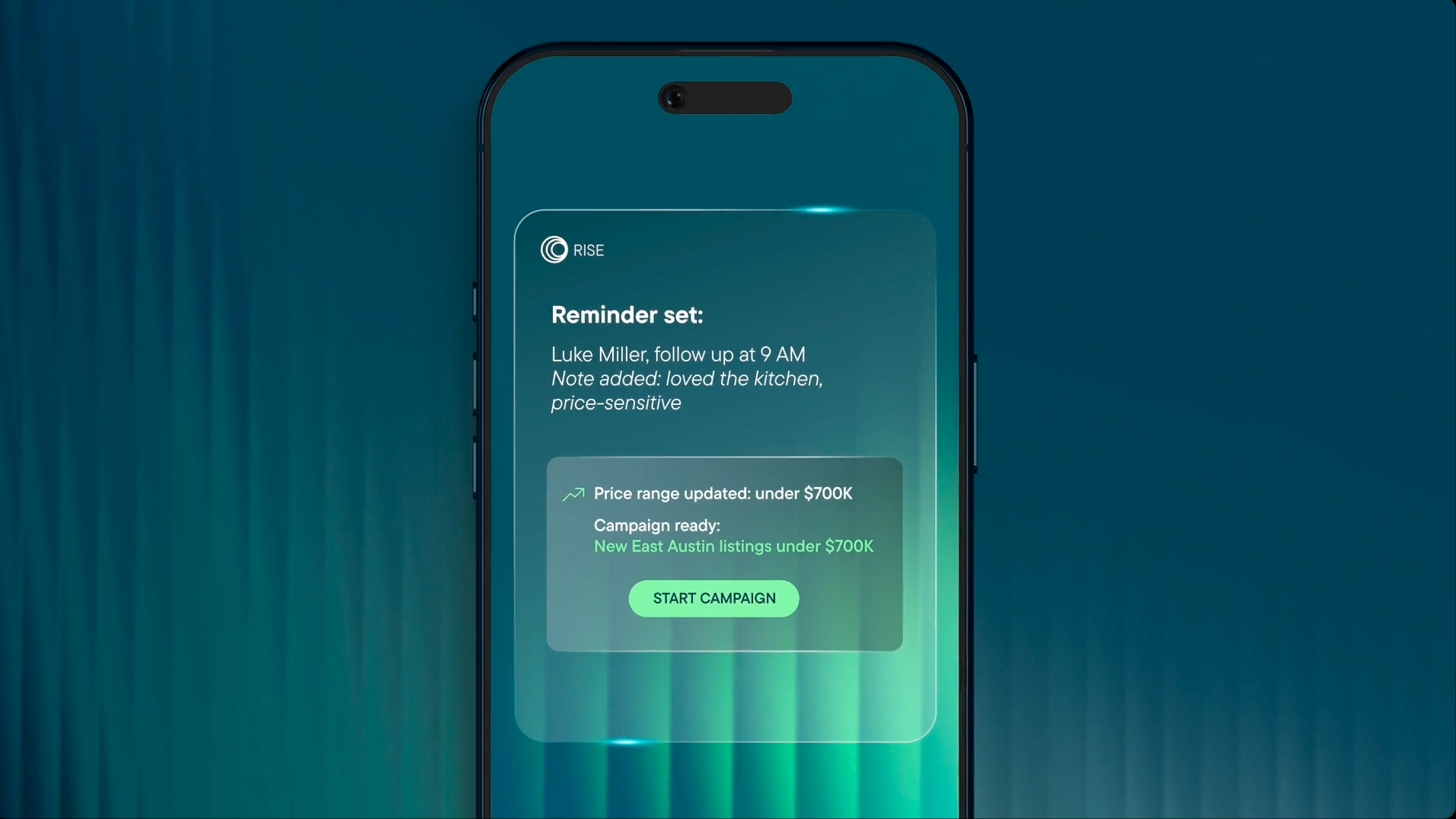
This is where RISE does some of its heaviest lifting. Agents start from pre-populated, brokerage-branded templates instead of a blank page, and your marketing team controls which templates and campaigns they can use. Dynamic content pulls in listing details and matches properties to each contact’s preferences, so buyers see homes that fit what they’re looking for. Smart Copy helps agents draft the message, and nothing sends without their approval. Finished Canva designs can be imported into the RISE Media Library and added to campaigns, too.
Then the follow-up keeps going. Listing announcements, market reports, home anniversaries, and follow-up sequences run automatically, and every open, click, and listing view feeds back into RISE, so agents know who’s engaging and when to pick up the phone.
And the emails get seen. More than 9 billion emails have been sent through the MoxiWorks platform at a 99.6% delivery rate, with an average 41% open rate and 3.7% click rate (MoxiWorks platform data, all-time, global).
Websites and landing pages
Depending on your site setup, agents shouldn’t need a designer or a developer to add a neighborhood page, update office hours, or build a simple campaign landing page with the right look. When agents can make basic updates themselves, without touching code or waiting on IT, they can share timely content and win new clients.
How To Ensure Consistency
Your brokerage should control approved logos, core colors, typography, legal and compliance language, required brokerage attribution, and base layouts, while agents work from templates they can personalize.
Most agents don’t need a design degree. They need a handful of rules they can apply without overthinking them.
Set guardrails for AI, too. AI tools can speed up routine creative work, but your brokerage needs clear rules on what counts as an acceptable edit versus a materially altered property image. Agents still have to comply with advertising rules, MLS policy, copyright, and Fair Housing standards. Speed doesn’t remove responsibility.
The Best Real Estate Design Solution For Brokerages
RISE by MoxiWorks, trusted by more than 3,000 brokerages and 400,000 agents globally, brings this all together.
It includes a Canva integration, so agents and brokerage marketing teams can import finished Canva designs straight into the RISE Media Library, ready for email campaigns and other marketing, instead of downloading and re-uploading them manually.
The outcome that matters isn’t the integration itself. It’s fewer disconnected steps, less exporting and re-uploading, more control over the templates agents start with, and a better chance the marketing gets made instead of abandoned halfway.
For four practical tips, see how to get real estate branding right at scale.